Description
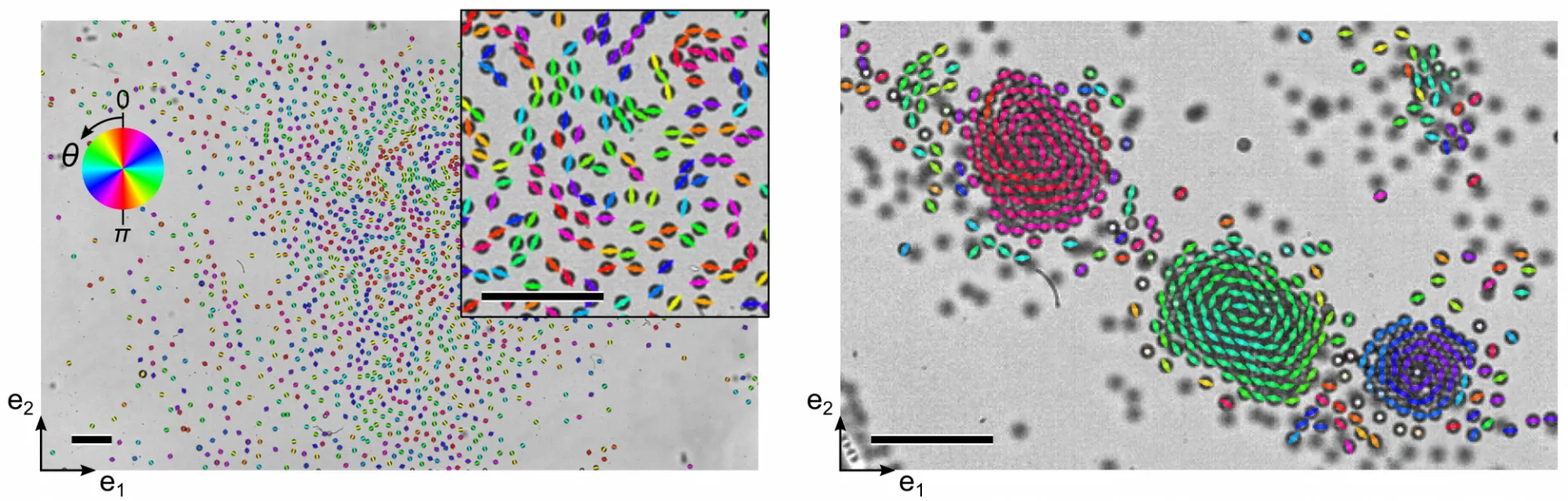
This project explores active oscillatory matter: assemblies of self-oscillating units whose intrinsic periodic dynamics interact through the surrounding fluid to produce collective behaviors inaccessible in equilibrium systems. Using Quincke oscillations of colloids near electrodes, we show that individual particles act as autonomous oscillators characterized by phase, frequency, and a nematic orientation. When brought together, hydrodynamic couplings drive simultaneous phase synchronization and orientational alignment, producing a new class of collective order—synchronematic order—observed in fluid-like clusters and finite crystalline assemblies. Experiments are combined with Stokesian-Dynamics simulations and reduced-order oscillator models to reveal how non-reciprocal interactions link synchronization to mutual acceleration and frequency shifts. Across geometries ranging from disordered fluids to linear arrays, these principles explain the emergence of coherent oscillations, circularly aligned clusters, and traveling waves, establishing active oscillatory matter as a model platform for studying nonequilibrium organization and for designing adaptive, frequency-tunable materials.