Description
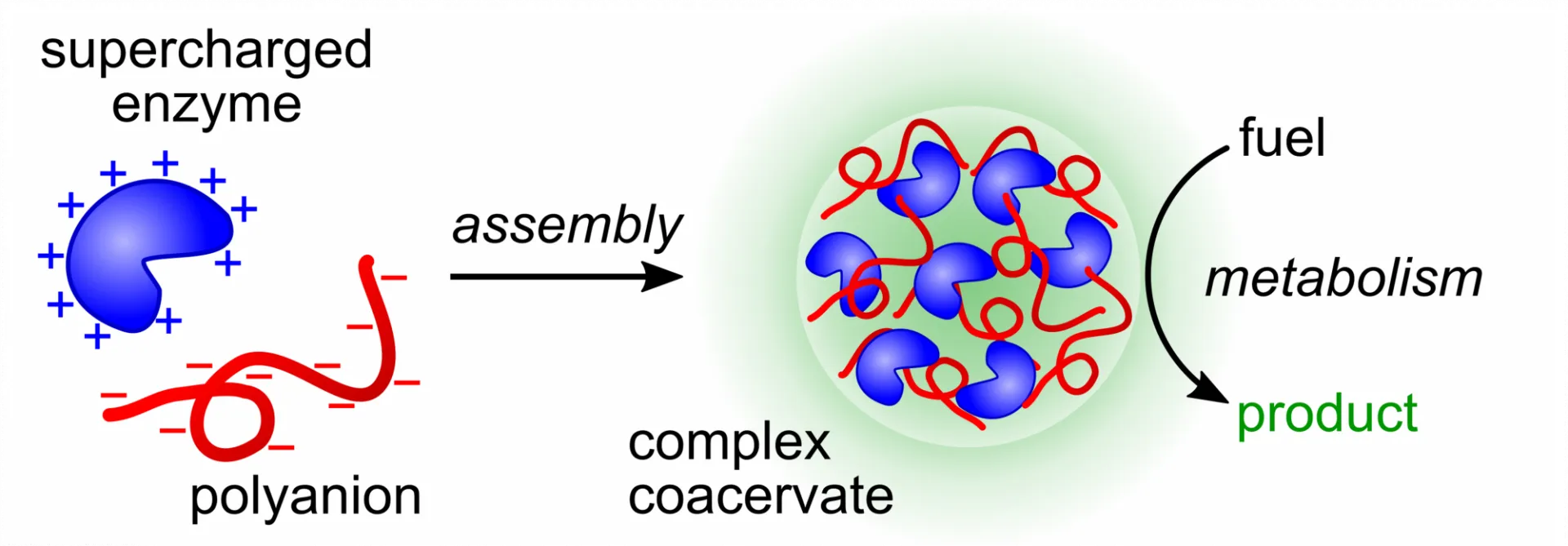
This project focuses on metabolic condensates: liquid-like droplets formed by complex coacervation in which enzymatic reactions actively control material organization. In these systems, enzymes localized within a condensed phase generate reaction products that modify local physicochemical conditions—such as pH—thereby feeding back on phase stability, rheology, and molecular transport. Depending on the relative rates of reaction, diffusion, and internal relaxation, metabolic activity can drive non-equilibrium behaviors including reversible changes in viscosity, formation of internal compartments, transient swelling and dissolution, and size-dependent stability. Through experiments and reaction–diffusion modeling across multiple enzyme–polymer chemistries, we identify general design principles by which dissipative chemical processes enable feedback control over condensate structure and dynamics. Together, this work establishes a framework for engineering active soft materials whose organization and function are autonomously regulated by internal metabolism, providing insight into the physical mechanisms underlying dynamic, membraneless compartments in both synthetic and biological systems.