Description
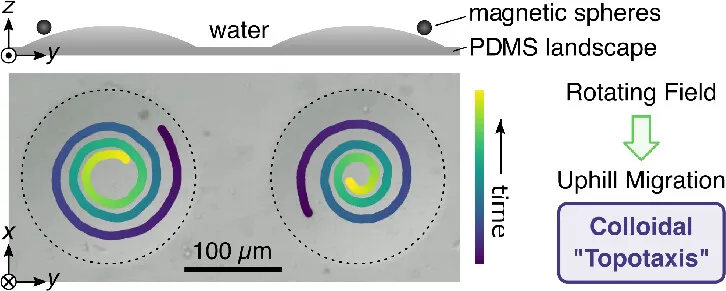
This project explores how magnetic microspheres and microswimmers can achieve self-guided navigation by responding autonomously to local environmental cues such as surface topography, fluid flow, and viscosity gradients. Rather than directing particles toward predefined destinations, we design time-varying magnetic fields that encode how particles respond to gradients they encounter, allowing many microrobots to navigate autonomously and independently under a common global field. Through a combination of experiments, dynamical modeling, and data-driven design, we demonstrate complementary taxis strategies—including topotaxis, rheotaxis, and viscotaxis—and identify fundamental tradeoffs between navigation performance and robustness. Together, these studies establish general design principles for magnetic microrobots with enhanced environmental awareness, with implications for navigation in biological systems, microfluidic transport, and autonomous function at the microscale.